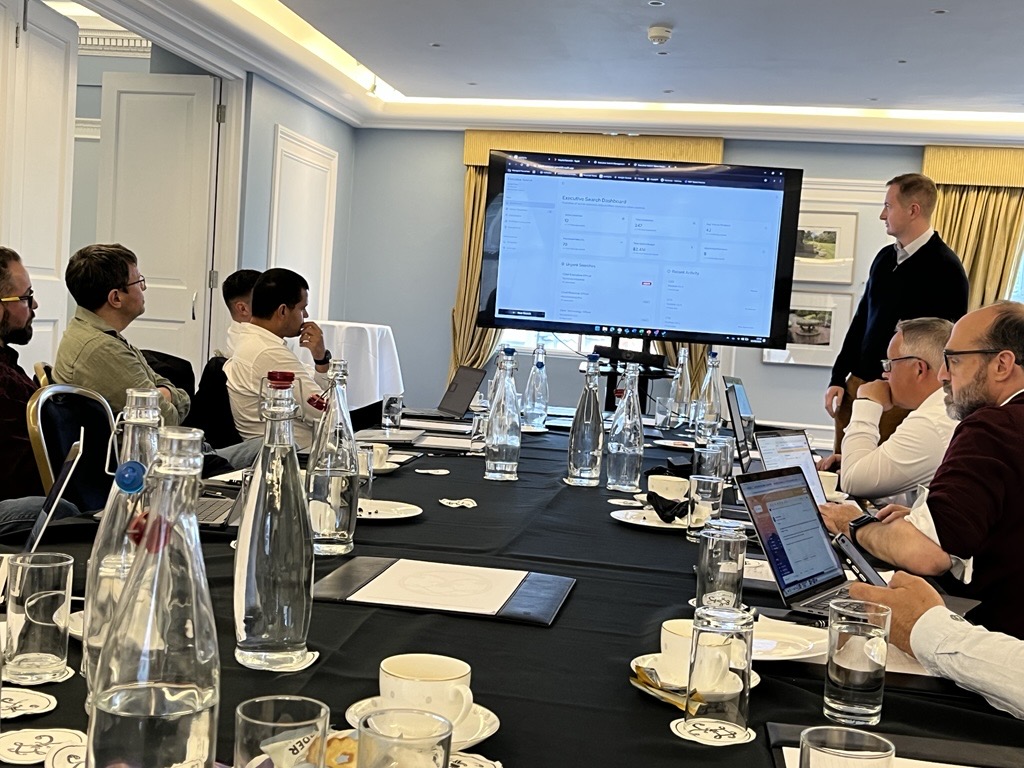


Reflections from Boost! Horizon

Whenever a new technology wave hits the mainstream the excitement comes first, then the scramble, then the inevitable attempt to treat the new thing as something to be plugged into the existing operating model, shown in a slide deck, and marked as progress.

Boost! Horizon made one point unmistakably clear: AI does not fit that pattern. It is not an add-on, just another tool to sit alongside the rest of the tech stack. It is a structural shift in how digital businesses will be designed, run, staffed, and scaled.
That distinction matters because businesses that treat AI as ‘a feature we should ship’ will likely miss the larger change already underway: AI is rewriting how work gets done, how products get built, and how competitive advantage is created.

“AI isn’t a tool. It’s something that’s much more transformational about how we operate.”

The illusion of “AI as a project”

A striking thread throughout the day was how often AI gets framed like a conventional initiative, a pilot, a transformation programme, or a digital workstream that can be scoped, funded, delivered, and moved on from.

AI behaves differently, it does not politely wait for annual planning cycles. The technology itself is evolving so fast that a project mindset almost guarantees obsolescence.

One panel discussion captured the paradox well. On the one hand, leaders are warned not to wait because competitors will move too quickly. On the other, they are reminded that what works in a demo rarely works in production.

This not a reason to disengage, instead it is a reason to build differently. The right question is not ‘how do we deliver an AI project?’ but ‘how do we build an organisation that can continuously absorb AI capability?’

“The winners will not be the companies with the best one-off AI experiment. They will be the companies that rewire themselves for constant iteration.”

The shrinking cost of building

If AI is a structural shift, it is because it changes the economics of creation and innovation. Several sessions demonstrated how quickly functional software can now be produced, even by people who are not traditional engineers. The premise of ‘everyone can be a builder’ is not just motivational language, it is a real organisational change.

When the cost of prototyping collapses, decision-making accelerates, experimentation becomes cheaper and iteration becomes continuous. The pace at which a company can test and validate its own ideas becomes a competitive advantage in itself.

Even more striking was the idea that teams can be dramatically smaller than traditional software builds require. One speaker described how AI-assisted development has reduced team size expectations to a fraction of what was once considered normal.

This is not simply productivity improvement; it is a structural shift in organisational design. It is changing how organisations staff themselves, what ‘capacity’ means and how they budget. It also changes how fast they can respond to market opportunities.

From technical advantage to cultural advantage

Ten years ago, the advantage in digital businesses was often technical with better infrastructure, better engineering talent and better data systems. Those things still matter, but Boost! Horizon surfaced a different idea: AI will increasingly reward cultural readiness.

The companies that win will be those that can adopt and adapt quickly, in theory and in practice. One panellist described how rapidly the planning cycle itself is being rewritten by the speed of AI change. The idea of committing to a single approach for a year is becoming outdated, because the tools themselves may shift within weeks.

“The cycle time of AI is different than any other technology that we’ve ever seen.”

This is why AI cannot simply be ‘owned by IT’, the structural shift is that AI becomes part of the organisational fabric. It has become something leaders need to understand at a working level, because strategic decisions increasingly depend on understanding what is now possible.

Speaker Matt Strain (the-prompt.ai) made the point that senior leaders often assume they can delegate AI to others, but without day-to-day familiarity, they will struggle to understand its real implications.

“I’ve met a number of senior leaders… that have said, ‘I have people on my team that do AI.’ I think that’s a real mistake.”

AI changes the shape of work itself

Another major undercurrent throughout the day was that AI is dissolving traditional boundaries between roles.

The lines between legal teams, risk teams, operations, marketing, product, and engineering are already shifting. This is not only because AI automates tasks, but because it enables people to perform tasks that were previously outside their skill set.

For example, a non-technical product manager can now prototype, a marketing lead can generate assets and test messaging faster, and a customer support team can deploy intelligent triage and resolution systems. At board-level, members can interrogate scenarios and model strategic outcomes with an AI co-pilot.

This is why AI is a reshaping force for the entire organisation, and with that comes discomfort. Governance and risk were framed as the disciplines needed to safely scale. Managing AI agents over time is itself a new operational competency, almost like supervising a new kind of workforce.

“How we supervise effectively our mini AI staff… is a new discipline.”

We are no longer talking just about tools, we are talking about systems that behave more like collaborators.

The new operating model: continuous experimentation

AI adoption is not a one-time transformation. It is a continuous cycle of testing, learning, refining, and scaling requiring organisations to be comfortable with unfinished versions. The panel on turning hype into impact repeatedly returned to the value of small pilots, fast iteration, and the discipline to stop what is not working.

“Try it, start small, prove out the concept. If it works, then build on it. If it doesn’t, kill it quick.”

In an environment where the underlying technology evolves rapidly, the most dangerous assumption is that you can design a perfect solution upfront. Instead, AI forces businesses to behave more like living systems: adaptive, responsive, and constantly evolving.

What this means for digital business builders

The most compelling takeaway from Boost! Horizon is that AI changes the logic of competition. If software becomes cheaper to create, then execution speed becomes more valuable. If intelligence becomes more accessible, then judgement becomes more valuable. And if content becomes easier to produce, then trust becomes more valuable.

AI is not simply improving existing businesses; it is redefining what a ‘well-run digital business’ looks like. AI is less like a new product category and more like a new layer of the economy that sits beneath everything else.

Businesses that treat AI as a feature will likely produce incremental improvements. But the businesses that treat AI as structural and integral will rebuild their organisations around it, creating a compounding advantage.

As the closing remarks at Boost! Horizon emphasised, the risk is not that leaders do too much too quickly, but that they ignore the shift entirely, waiting for certainty that will never arrive.

“The wrong answer is to just ignore it and wait until tomorrow.”

Mayfair’s Boost! programme exists to strengthen connections and unlock value across portfolio businesses. Boost! Horizon was designed specifically for senior leaders and board members across our portfolio to create space for strategic thinking and be a practical forum for the reality of executive decision-making in a world where technological change is no longer incremental, but structural.
Previous experience

Education and qualifications

Reflections from Boost! Horizon

Capability is becoming abundant

AI capability is spreading fast with powerful and accessible tools increasingly embedded in everyday workflows. The real question facing leadership teams is no longer whether AI works, but whether it can be trusted.

Only a few years ago, AI felt specialist and technical. Today, it feels almost ubiquitous, from prompt-driven content creation to agentic systems that build and deploy applications in minutes. As one speaker demonstrated, the barrier to entry has fallen dramatically and complex workflows that once took weeks can now be prototyped in hours.

This democratisation is profound. It changes who can build, who can experiment and who can innovate. But when everyone has access to similar foundational models, how can organisations differentiate themselves?

From demo to production: the credibility gap

In the context of customer-facing AI agents, the distinction was made clearly. A pilot can show promise, and a demo can impress, but production environments demand resilience, monitoring and governance.

This is the credibility gap. It is one thing to generate an answer and another to ensure that answer is consistent, explainable and aligned with policy. It is one thing to write code from a prompt, another to integrate that code into regulated, customer-critical systems. Trust has become a technical, operational and cultural capability.

Data as a reputation asset

AI is increasingly becoming the interface between businesses and their customers, which means the quality of the data feeding it has become a matter of brand equity.

One vivid example illustrated how domain-specific context transforms performance. A generic model, given an image of a broken machine part, produced plausible but incorrect recommendations. A different system that was grounded in validated internal documentation identified the correct part and repair path

The lesson from this is straightforward. General intelligence is powerful, but contextual intelligence is decisive.

Organisations that treat their data as an afterthought will struggle. Those that curate, validate and structure their data effectively create a trust layer around AI outputs. That layer is not cosmetic. It is foundational.

In this sense, data maturity is no longer just an analytics question. It is a credibility question.

Governance as an enabler, not a brake

It is tempting to frame governance as the counterweight to innovation but at Boost! Horizon, that narrative was challenged. In highly regulated industries, AI is already live in agentic form, but the challenge is how to supervise it.
The companies making progress are not ignoring risk, they are building mechanisms to manage it. Guardrails, red teaming, contractual controls and clear data boundaries were discussed as practical tools, not theoretical safeguards.
Crucially, leadership ownership was emphasised. AI cannot be delegated entirely to technical teams; it must have a seat at board level. Governance, done well, accelerates deployment and allows businesses to move faster because they understand the boundaries.

Trust as commercial advantage

When AI-powered interfaces become the first point of contact for customers they will judge not just speed or novelty, but reliability. Trust will shift from a marketing promise to an operational reality. If the system hallucinates, misprices or mishandles sensitive data, the brand absorbs the impact immediately. And when AI interfaces consistently deliver accurate, relevant and transparent responses, it enhances the customer experience in a measurable way.

It is no longer enough to say, “We use AI.” The more meaningful statement is, “Our AI works reliably, securely and responsibly at scale.”

Beyond hype

The phrase ‘beyond hype’ surfaced more than once during the day. Artificial intelligence is embedded, shaping product development, customer service, marketing and operations. At Boost! Horizon, the message was clear. The next competitive advantage in AI will not be capability alone.

Credibility is harder to build. It requires investment in data, architecture, governance and culture, and leaders who are willing to engage deeply rather than outsource understanding. In a landscape defined by rapid change, trust will become the most durable differentiator.

Mayfair’s Boost! programme exists to strengthen connections and unlock value across portfolio businesses. Boost! Horizon was designed specifically for senior leaders and board members across our portfolio to create space for strategic thinking and be a practical forum for the reality of executive decision-making in a world where technological change is no longer incremental, but structural.


Previous experience

Education and qualifications

Mayfair Equity’s bi-annual Boost Technology Forum is part of Boost!, our firm’s networking and development programme, intended to spark collaboration across the portfolio, strengthen connections, and provide our management teams with practical tools and insights. Through a series of curated events, we aim to unlock potential by empowering individuals, adding value to businesses, and shaping the digital leaders of tomorrow.

We brought together CTOs and CPOs from our portfolio to explore how agentic AI and vibe coding is transforming the future of business. Hosted by Thomas Nielsen, one of our Growth Specialists, and facilitated by Replit, the forum was designed as a hands-on workshop rather than a theoretical discussion.

During the day, participants worked side by side with the Replit team to prototype automation use cases, experiment with new workflows, and define pilot projects that could create measurable value for their organisations. The result was a day of collaboration that combined practical problem-solving with forward-looking strategy.

For Thomas, the forum epitomised Mayfair’s mission to build leaders equipped to thrive in a world of disruption.

“We’re a firm that doesn’t just invest in companies, we are actively investing in building digital leaders,” Nielsen said. “Harnessing technology isn’t optional, it’s the pathway to leadership. We give our management teams the tools, networks, and confidence to transform the way they work, and ultimately, the way their industries operate.”

Our teams saw first-hand how agentic AI can accelerate the transition from service-led workflows to scalable, productised capabilities. A demonstration from the Replit team showed how processes relevant to our companies, such as onboarding, ticket triage, and reporting can be developed and tested in minutes, not days! By the afternoon, our portfolio company teams were sharing prototypes that illustrated not only the technical feasibility of AI-enabled workflows but also the business impact they could deliver.

The discussion extended beyond technology into the organisational implications of automation. Leaders examined how AI would affect roles, governance, and the integration of automation into existing teams and processes.

Reflecting on the forum, Nielsen highlighted Mayfair’s long-term vision for its portfolio companies.

“Our role is to help our management teams build businesses that thrive in a world defined by change,” he said. “Agentic AI is a critical enabler of that journey. The Boost! Technology Forum showed just how ready they are to embrace the opportunity, and we are committed to standing shoulder to shoulder with them as they shape the future of their industries.”

Sharing a Replit-generated prototype

Previous experience

Education and qualifications

Previous experience

Education and qualifications