

Reflections from Boost! HorizonSoftware creation is changing fast
One of the clearest takeaways from Boost! Horizon was that the biggest impact of AI may not be in analysis, research or content generation, but in how quickly organisations can now turn ideas into working software.
The Replit session in particular landed strongly because it demonstrated something that many leaders instinctively understand but have not yet seen in practice: that prototyping is no longer limited to engineering teams. The gap between a business problem and a functional digital solution is reducing rapidly, with implications for speed, innovation, productivity and competitive advantage.
Why this matters: prototyping has always been a bottleneck
In most organisations, the ability to build software has historically been constrained by engineering capacity. A marketing team might want a campaign microsite, an operations lead might want a workflow tool, or a product team might want to test a new feature, all competing for attention and resource.
At Boost! Horizon, the shift being discussed was not just ‘AI makes engineers more productive’. It was the idea that AI is changing who can build, and how quickly they can do it.
“What we believe is the next wave of software creators really is right here in this room, no matter what technical background you might have.”
This is not about removing the need for engineering, rather it is about changing the front end of innovation. If teams can prototype solutions themselves, engineering effort can be directed towards scaling, security and integration, rather than get tied up in early-stage experimentation.
The rise of “prompt-to-software”
The most significant development highlighted in the Replit demonstration was that natural language is becoming a usable interface for building digital tools. Rather than writing code line by line, users describe what they want and iterate on the output until it works.
The pace of experimentation has changed and along with that the costs of trying something new. Many ideas that would previously have required a formal project, a development roadmap, and multiple approval steps can now be tested much more quickly.
The first version of a product or tool is rarely the final one, so the ability to test and adapt quickly is increasingly becoming part of how digital businesses compete.
Engineering is not going away, but its role is shifting
A key point that came through clearly during the day is that demos are not the same as production systems. Tools can dramatically accelerate prototyping, but businesses still need technical leadership to ensure that what is built is secure, maintainable and scalable.
However, the underlying shift remains: the early-stage work that traditionally sat exclusively with engineers is increasingly becoming accessible to non-technical teams, changing what engineering teams spend time on.
It also changes the nature of internal innovation. Organisations can experiment more widely because the cost of failure is lower. A prototype can be built quickly, tested quickly, and either improved or abandoned without large sunk costs.
The organisational implication: more builders, more momentum
Many internal business processes are still held together by spreadsheets, manual reporting, email chains and repeated admin. These problems often persist not because they are hard to solve, but because they never rise high enough on a product or engineering backlog to justify investment.
“But we’re thinking, what if everyone in your company was a builder?”
AI-enabled prototyping changes that equation. If teams can build small internal tools quickly, a large number of ‘minor’ problems can be solved in ways that compound over time. Over the next few years, the companies that move fastest are likely to be the ones that treat prototyping as a distributed capability rather than a centralised function.
A competitive advantage hiding in plain sight
The most commercially relevant implication is speed. If software becomes easier to prototype, competitors can test ideas faster, launch internal tools faster, and improve customer-facing workflows faster.
For management teams, this raises a strategic question: if a competitor can build and test a tool in days, what happens to businesses still operating on quarterly planning cycles for digital delivery? In digital markets, product differentiation is often driven by user experience, responsiveness, and the ability to adapt to shifting customer behaviour, making this level of productivity highly relevant.
What Boost! Horizon revealed
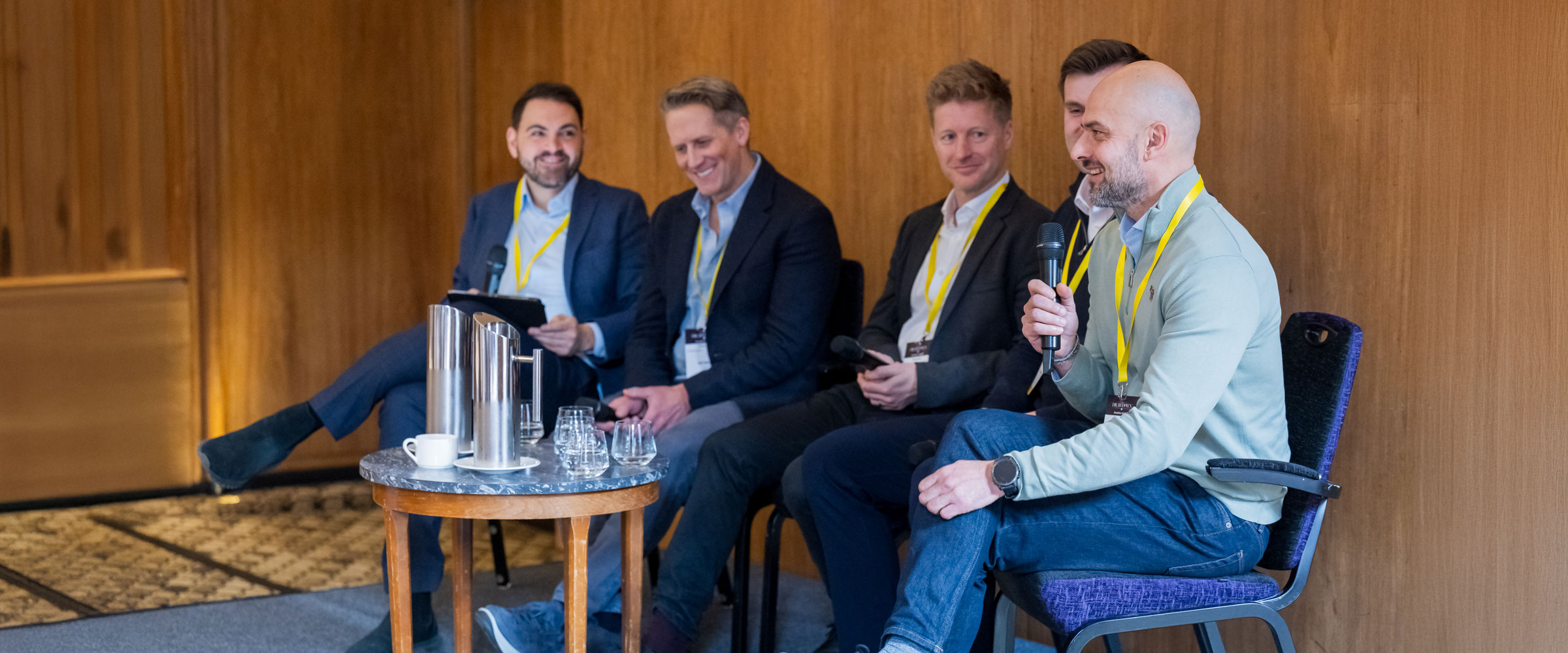
Boost! Horizon was not framed as a ‘future vision’ conference. It was a practical look at what is already possible today. The Replit session demonstrated that software creation is becoming more accessible, more iterative, and more embedded into day-to-day business problem-solving.
“Unless you’re using AI on a day-to-day basis, it’s really hard to understand how magical it is.”
The larger takeaway is straightforward: AI is not just changing what software can do. It is changing who can create it, and how quickly it can be created, a major shift in how innovation happens.
Mayfair’s Boost! programme exists to strengthen connections and unlock value across portfolio businesses. Boost! Horizon was designed specifically for senior leaders and board members across our portfolio to create space for strategic thinking and be a practical forum for the reality of executive decision-making in a world where technological change is no longer incremental, but structural.