

When people talk about AI, the assumption is often that it belongs to engineers and developers. At Mayfair, we are seeing something different: the most exciting breakthroughs often come from people who simply spot a problem, stay curious, and are willing to experiment.
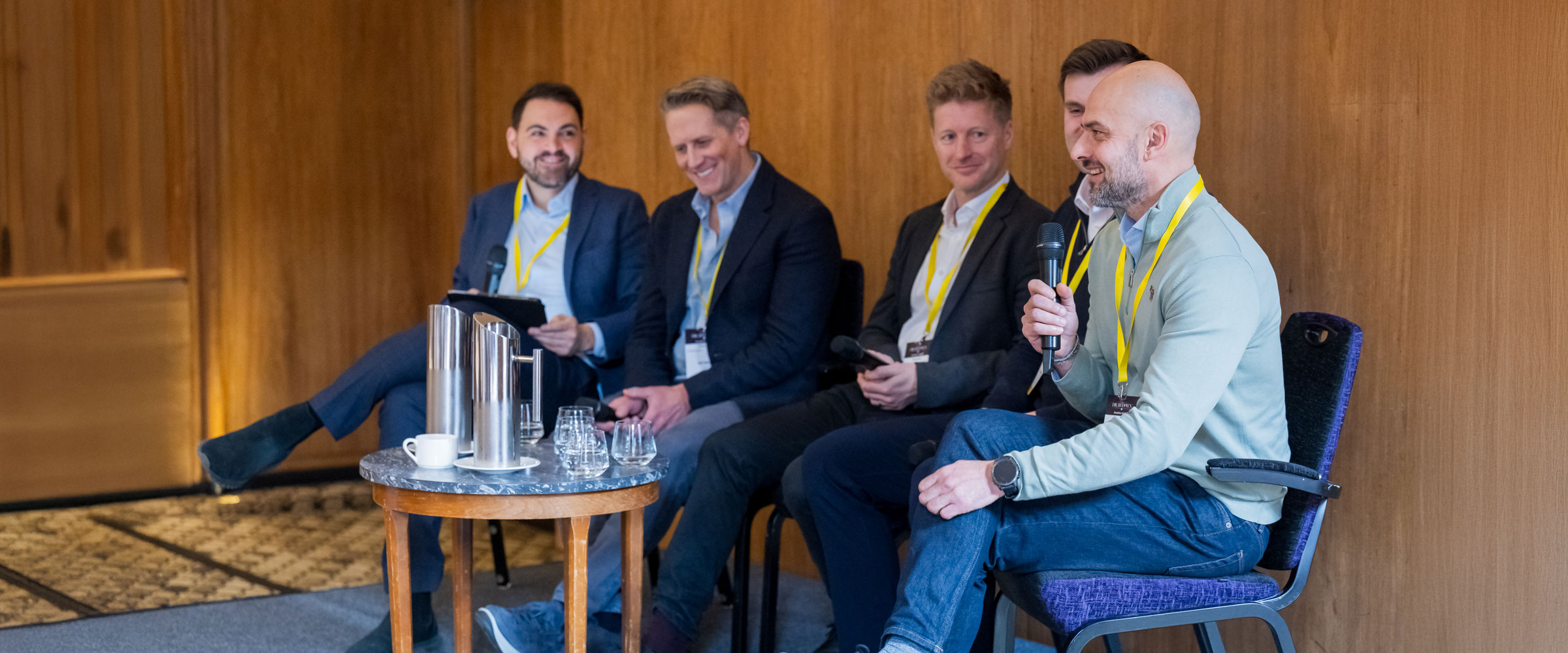
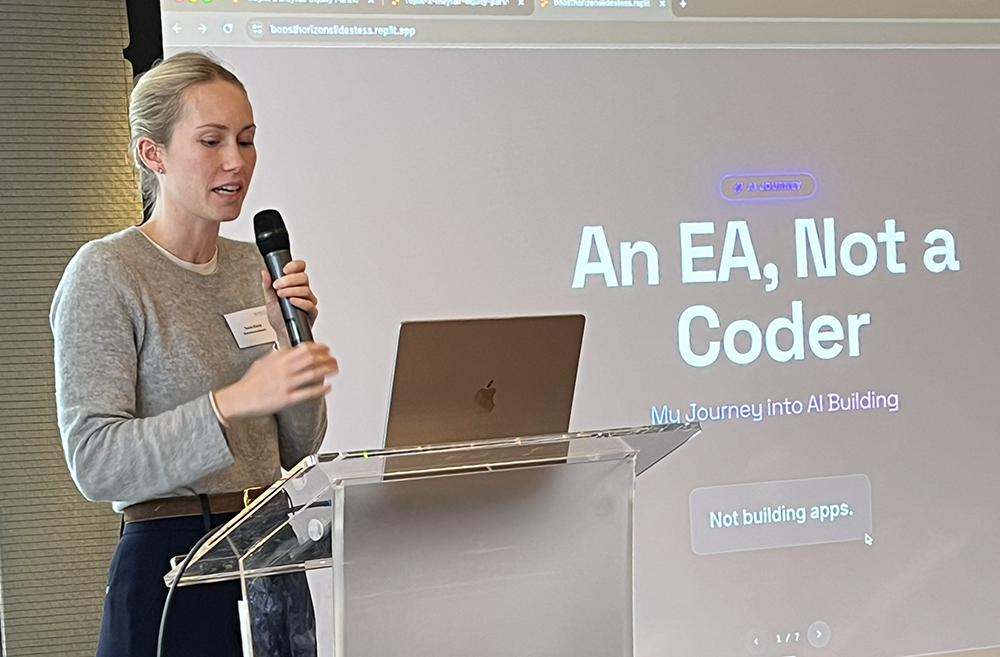
At Mayfair’s recent Boost! Horizon event for portfolio CEOs and board members, Tessa Remp, an executive assistant in our team, presented the live event portal she had built herself using Replit. Tess is not a developer, and has never written a line of code, yet within weeks, she had produced a professional web app that delegates could access throughout the event.
“I’m an EA, not a developer. I know absolutely no code,” Tessa told the audience. “But I wanted to show that you don’t need to be technical to create something useful.”
From curiosity to a real product
It began when Mayfair hosted an internal hackathon for its portfolio CTOs with Replit, an AI-powered coding environment that allows users to build software through natural language prompts, turning plain English into working code.
The brief was deliberately open. Participants were encouraged to bring ideas rather than technical expertise, and to use natural language to turn those ideas into working software. The focus was not on building something perfect, but on understanding what AI makes possible.
“I realised there were no expectations for me to be technical,” Tessa said. “We brought our ideas to the table and watched them turn into code.”
Solving a real event problem
As part of her role supporting Mayfair’s events programme, Tessa decided to build a live event portal that moved from a simple concept to a fully functioning solution for a high-profile gathering of portfolio CEOs. Using Replit and straightforward prompts, she created an app featuring an instantly updateable agenda, speaker profiles with photos and LinkedIn links, a Citymapper-inspired travel planner to help delegates navigate to the venue, and live local weather updates.
What followed was a rapid build process driven entirely by prompts, experimentation and iteration. Tessa integrated the web app with Transport for London and weather services, despite not knowing what an API was, or how it worked behind the scenes.
“If you don’t know what API stands for, neither do I,” Tessa joked during the presentation. “But I got the gist of what it does.”
She also used Replit’s design tooling to generate a polished one-page agenda, including speaker photos, interactive elements, and embedded LinkedIn links. Pushing it further, she prompted the platform to create a moving image of the Shard to bring the portal to life, inspired by the visual design on other firms’ websites.
Working fast, learning faster
On the day of the event, Tessa realised that registration was being managed through a simple Excel checklist. With minutes to spare, she asked Replit to create a one page check-in tool. She pasted in a rough list of names and refined the output until it did exactly what was needed: tick attendees off, track arrivals and highlight who was missing. The entire tool was built in around five minutes.
Not every feature worked perfectly, but instead of being discouraged, she treated it as part of the process.
“One of the biggest lessons is that AI doesn’t always understand you the first time, or maybe even the fifth,” Tessa said. “It’s a conversation. You have to work with it.”
Key lessons: curiosity beats expertise
Tess approached the tooling with curiosity, she tested ideas quickly, asked the AI to suggest improvements, and treated every version as something that could evolve.
It was a useful reminder that deep technical knowledge can sometimes get in the way. Some of the more technically experienced participants over-engineered their projects, bringing assumptions and complexity that limited what the AI could do. By contrast, starting with plain English and curiosity proved to be an advantage.
“The most remarkable part was that Tessa built the strongest application in a room full of technical people. It was a real reminder that AI is shifting what ‘building’ looks like.”
Investing in our team, and the future
This experience reflects how we think about AI at Mayfair. We see it as a productivity tool for everyone, not just specialists. This is why we actively collaborate with leading AI companies like Replit, and why we create opportunities for our team to explore emerging tools in a practical way.
“I didn’t think I could do this six months ago,” Tessa said. “But once you start exploring, you realise how much is possible.”
A few years ago, the idea that anyone in the organization could build and deploy a live web app for an international event would have seemed unlikely. Six months ago, Tessa would not have expected it herself, but today, it is simply part of how we work.