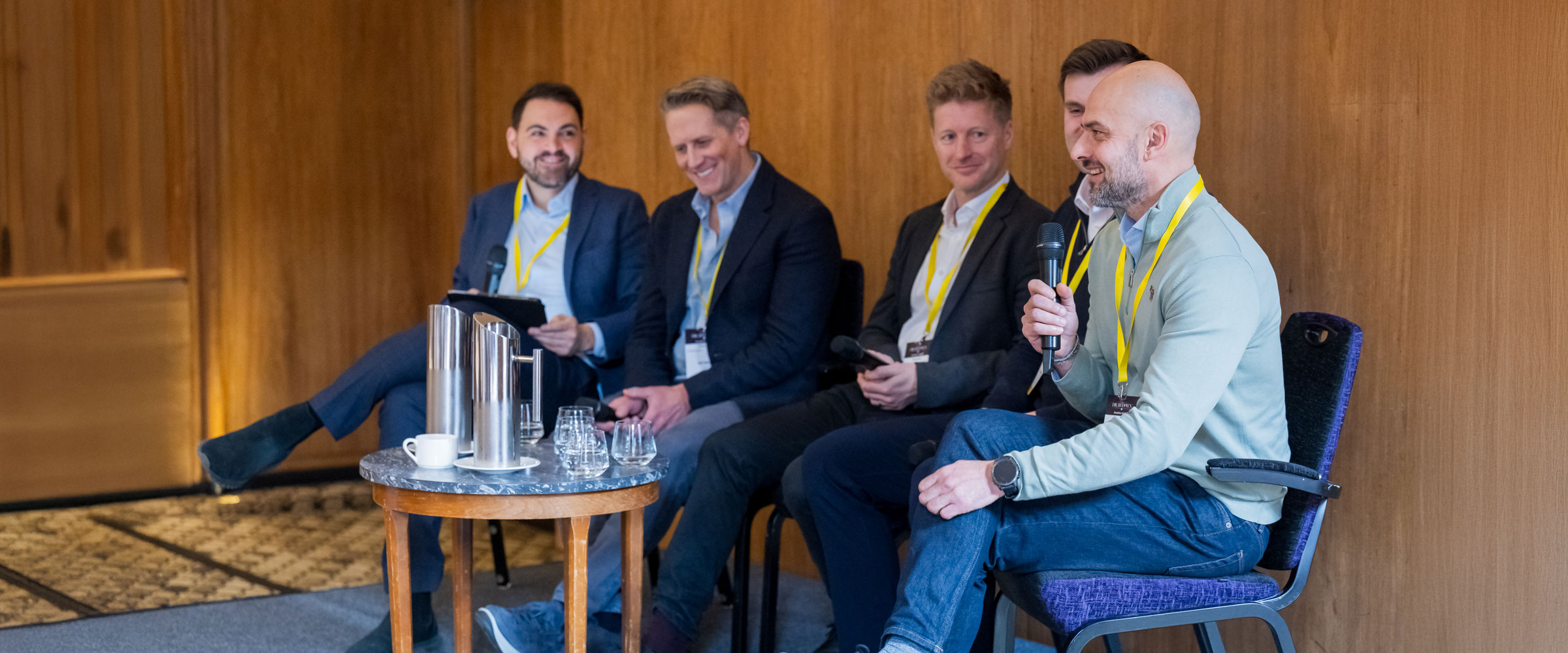


Reflections from Boost! HorizonWhenever a new technology wave hits the mainstream the excitement comes first, then the scramble, then the inevitable attempt to treat the new thing as something to be plugged into the existing operating model, shown in a slide deck, and marked as progress.
Boost! Horizon made one point unmistakably clear: AI does not fit that pattern. It is not an add-on, just another tool to sit alongside the rest of the tech stack. It is a structural shift in how digital businesses will be designed, run, staffed, and scaled.
That distinction matters because businesses that treat AI as ‘a feature we should ship’ will likely miss the larger change already underway: AI is rewriting how work gets done, how products get built, and how competitive advantage is created.
“AI isn’t a tool. It’s something that’s much more transformational about how we operate.”
The illusion of “AI as a project”
A striking thread throughout the day was how often AI gets framed like a conventional initiative, a pilot, a transformation programme, or a digital workstream that can be scoped, funded, delivered, and moved on from.
AI behaves differently, it does not politely wait for annual planning cycles. The technology itself is evolving so fast that a project mindset almost guarantees obsolescence.
One panel discussion captured the paradox well. On the one hand, leaders are warned not to wait because competitors will move too quickly. On the other, they are reminded that what works in a demo rarely works in production.
This not a reason to disengage, instead it is a reason to build differently. The right question is not ‘how do we deliver an AI project?’ but ‘how do we build an organisation that can continuously absorb AI capability?’
“The winners will not be the companies with the best one-off AI experiment. They will be the companies that rewire themselves for constant iteration.”
The shrinking cost of building
If AI is a structural shift, it is because it changes the economics of creation and innovation. Several sessions demonstrated how quickly functional software can now be produced, even by people who are not traditional engineers. The premise of ‘everyone can be a builder’ is not just motivational language, it is a real organisational change.
When the cost of prototyping collapses, decision-making accelerates, experimentation becomes cheaper and iteration becomes continuous. The pace at which a company can test and validate its own ideas becomes a competitive advantage in itself.
Even more striking was the idea that teams can be dramatically smaller than traditional software builds require. One speaker described how AI-assisted development has reduced team size expectations to a fraction of what was once considered normal.
This is not simply productivity improvement; it is a structural shift in organisational design. It is changing how organisations staff themselves, what ‘capacity’ means and how they budget. It also changes how fast they can respond to market opportunities.
From technical advantage to cultural advantage
Ten years ago, the advantage in digital businesses was often technical with better infrastructure, better engineering talent and better data systems. Those things still matter, but Boost! Horizon surfaced a different idea: AI will increasingly reward cultural readiness.
The companies that win will be those that can adopt and adapt quickly, in theory and in practice. One panellist described how rapidly the planning cycle itself is being rewritten by the speed of AI change. The idea of committing to a single approach for a year is becoming outdated, because the tools themselves may shift within weeks.
“The cycle time of AI is different than any other technology that we’ve ever seen.”
This is why AI cannot simply be ‘owned by IT’, the structural shift is that AI becomes part of the organisational fabric. It has become something leaders need to understand at a working level, because strategic decisions increasingly depend on understanding what is now possible.
Speaker Matt Strain (the-prompt.ai) made the point that senior leaders often assume they can delegate AI to others, but without day-to-day familiarity, they will struggle to understand its real implications.
“I’ve met a number of senior leaders… that have said, ‘I have people on my team that do AI.’ I think that’s a real mistake.”
AI changes the shape of work itself
Another major undercurrent throughout the day was that AI is dissolving traditional boundaries between roles.
The lines between legal teams, risk teams, operations, marketing, product, and engineering are already shifting. This is not only because AI automates tasks, but because it enables people to perform tasks that were previously outside their skill set.
For example, a non-technical product manager can now prototype, a marketing lead can generate assets and test messaging faster, and a customer support team can deploy intelligent triage and resolution systems. At board-level, members can interrogate scenarios and model strategic outcomes with an AI co-pilot.
This is why AI is a reshaping force for the entire organisation, and with that comes discomfort. Governance and risk were framed as the disciplines needed to safely scale. Managing AI agents over time is itself a new operational competency, almost like supervising a new kind of workforce.
“How we supervise effectively our mini AI staff… is a new discipline.”
We are no longer talking just about tools, we are talking about systems that behave more like collaborators.
The new operating model: continuous experimentation
AI adoption is not a one-time transformation. It is a continuous cycle of testing, learning, refining, and scaling requiring organisations to be comfortable with unfinished versions. The panel on turning hype into impact repeatedly returned to the value of small pilots, fast iteration, and the discipline to stop what is not working.
“Try it, start small, prove out the concept. If it works, then build on it. If it doesn’t, kill it quick.”
In an environment where the underlying technology evolves rapidly, the most dangerous assumption is that you can design a perfect solution upfront. Instead, AI forces businesses to behave more like living systems: adaptive, responsive, and constantly evolving.
What this means for digital business builders
The most compelling takeaway from Boost! Horizon is that AI changes the logic of competition. If software becomes cheaper to create, then execution speed becomes more valuable. If intelligence becomes more accessible, then judgement becomes more valuable. And if content becomes easier to produce, then trust becomes more valuable.
AI is not simply improving existing businesses; it is redefining what a ‘well-run digital business’ looks like. AI is less like a new product category and more like a new layer of the economy that sits beneath everything else.
Businesses that treat AI as a feature will likely produce incremental improvements. But the businesses that treat AI as structural and integral will rebuild their organisations around it, creating a compounding advantage.
As the closing remarks at Boost! Horizon emphasised, the risk is not that leaders do too much too quickly, but that they ignore the shift entirely, waiting for certainty that will never arrive.
“The wrong answer is to just ignore it and wait until tomorrow.”